
Deriv TradingView Implementation Guide for Kenyan Traders
Deriv Signal Bot — Free & Paid Tools for Kenya Traders
Want automated trading without the scam risk? Most "free Deriv bots" circulating online are malware or outdated strategies — but legitimate alternatives exist. This guide reveals which Deriv signal tools actually work for Kenyan traders, and why Stockity's built-in analytical tools offer a safer path to consistent profits.
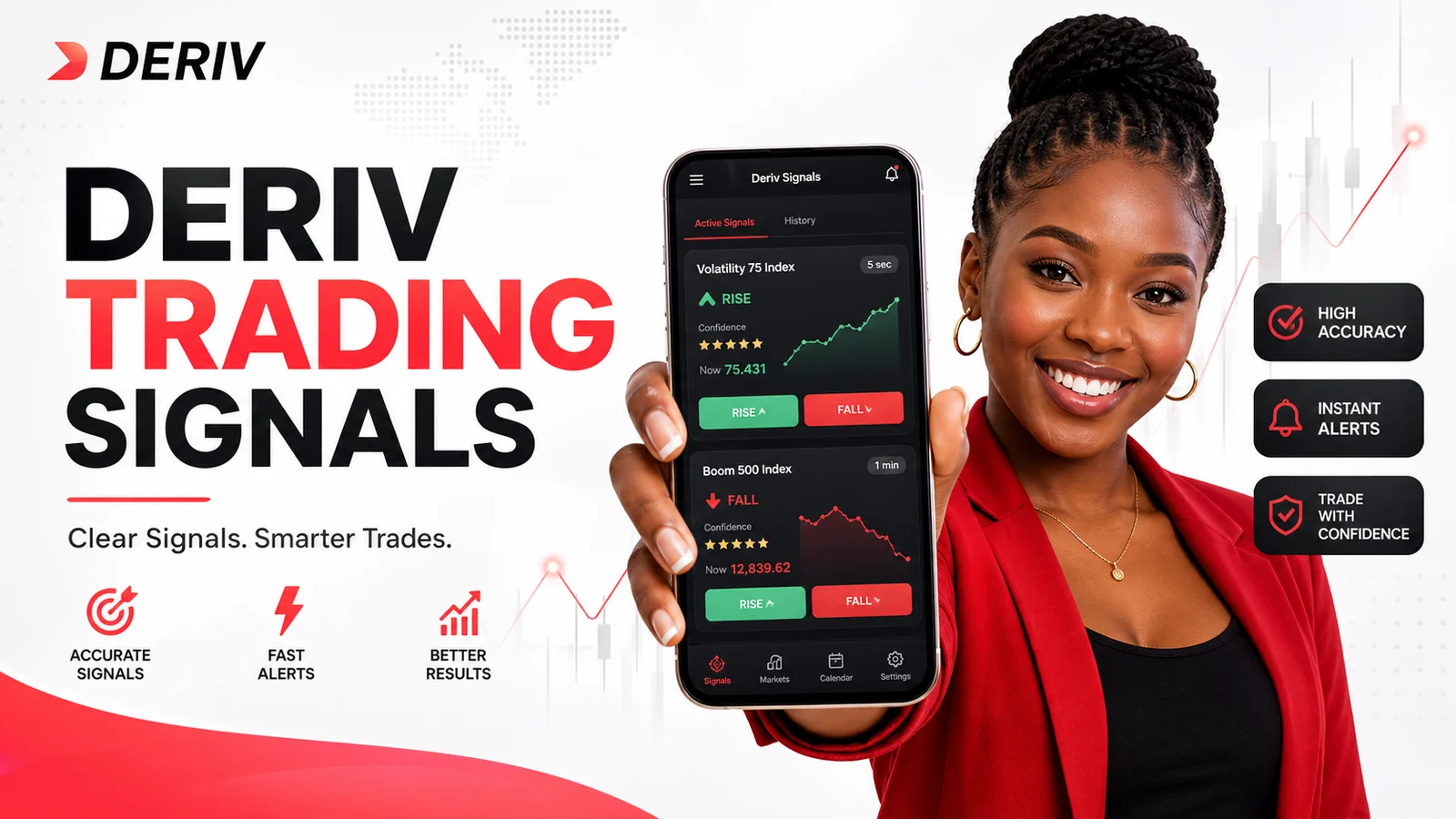

What Is a Deriv Signal Bot?
A Deriv signal bot is an automated software that analyses market data and generates buy/sell signals based on predefined strategies. These bots can run on Deriv's platforms like MT5 or Deriv Trader, executing trades without manual intervention. Kenyan traders often search for "deriv bot xml free download" or "no loss deriv bot free download," hoping to replicate profitable strategies.
The term "signal bot" covers two main categories: official tools provided by Deriv (like Deriv Bot, a visual scripting tool) and third-party bots shared on forums, Telegram, or as XML files. Official bots are safer but limited in functionality. Third-party bots promise higher returns but often lack transparency.
Key Takeaway: No bot guarantees "no loss." Any tool claiming 100% win rate is a red flag. Legitimate bots reduce emotional trading but still carry market risk.
Official Deriv Tools: Deriv Bot & MT5 EAs
Deriv provides two official automation tools: Deriv Bot (visual scripting for Deriv Trader) and MT5 Expert Advisors (EAs) for the MT5 platform. Deriv Bot lets you create strategies using drag-and-drop blocks — no coding required. You can set entry rules, stop-loss, and take-profit levels. MT5 EAs require MQL5 programming knowledge but offer more flexibility.
Deriv Bot features:
- Free to use with any Deriv account
- Supports forex, synthetics, and indices
- Backtesting capability (test strategies on historical data)
- No third-party risk — runs on Deriv's servers
Limitations for Kenya traders:
- No built-in signal generation — you must create your own strategy from scratch
- Requires consistent internet connection (critical in areas with frequent outages)
- Limited to Deriv's asset list (no local Kenyan stocks like EABL or Safaricom)
For beginners, Deriv Bot is a good starting point. But it's not a "signal bot" in the traditional sense — it's a strategy builder. True signal bots, like those from third-party providers, claim to do the analysis for you.
Third-Party Bots: XML & Telegram Risks
The internet is flooded with "deriv bot xml free download" links and Telegram groups promising "dollar printer deriv bot" strategies. These files are often shared as XML configurations for Deriv Bot or MT5 EAs. While some are legitimate backtests, most are scams or outdated.
Common types of third-party bots:
- XML strategy files – Pre-configured Deriv Bot strategies shared on forums like ForexFactory or Reddit
- Telegram signal bots – Channels that send buy/sell alerts (e.g., "Deriv Signal Bot Telegram")
- Paid EA packages – Sold for $50–$500, claiming "no loss" or "best deriv bot strategy"
Risks for Kenyan traders:
- Malware: Downloaded XML files may contain malicious scripts
- Outdated logic: Strategies that worked in 2023 may fail in 2026 markets
- No accountability: Sellers vanish after payment
- Over-optimisation: Backtests look perfect but fail live
A Kenyan trader recently lost KSh 15,000 after buying a "no loss deriv bot" from a Telegram channel. The bot opened 20 losing trades in one hour. Always test third-party bots on a demo account first.
Key Takeaway: Never run a third-party bot on a live account without extensive demo testing. Even then, be prepared for losses.
Deriv Bot Strategies That Work
- 01
Martingale with stop-loss
– Double position size after losses, but cap at 5 consecutive losses
- 02
Trend following
– Use moving averages (e.g., 50/200 EMA crossover) on synthetics
- 03
Scalping on volatility indices
– 1-minute charts with tight stop-losses (10–20 pips)
- 04
Grid trading
– Place buy/sell orders at fixed intervals (risky in trending markets)
Trade on integrated tools
Audited indicators, real-time data feed.
Deriv Bots vs Stockity Tools
Stockity offers a different approach: built-in analytical tools that don't require bots. Instead of automating trades, Stockity provides real-time signals, technical indicators, and risk management features — all within a CMA-regulated platform.
Why Stockity wins for Kenya traders:
- No need to download risky XML files
- Instant M-Pesa deposits/withdrawals
- Lower minimum deposit (KSh 500 vs KSh 1,000)
- CMA regulation means legal protection
Skip the third-party bot risk
Built-in indicators, no external software.
Common Deriv Bot Issues & Fixes
- 01
Bot not executing trades
– Check internet connection and ensure Deriv Bot is running on a live server (not local PC). Solution: Use a VPS (Virtual Private Server) for 24/7 uptime.
- 02
XML file not loading
– The file may be corrupted or incompatible with your Deriv Bot version. Solution: Download fresh from official sources or re-export from Deriv Bot.
- 03
Excessive losses in first hour
– The bot may be over-leveraged or using a Martingale strategy. Solution: Reduce lot size to 0.01 and test on demo for 50 trades.
- 04
Telegram signals not matching trades
– Signal providers often delay alerts by 5–10 minutes. Solution: Use a bot that executes signals automatically (e.g., via API) or switch to manual trading.
- 05
Account flagged for automated trading
– Deriv may restrict accounts using third-party bots. Solution: Use only official Deriv Bot or MT5 EAs.
- 06
Withdrawal delays after bot losses
– If the bot drains your account, withdrawals may be delayed due to negative balance. Solution: Set a daily loss limit in the bot settings.
- 07
Bot stops working after Deriv update
– Platform updates can break XML strategies. Solution: Check Deriv's changelog and update your bot configuration.
Get verified tools
RSI, MACD, MAs — all in the platform.
Final Verdict: Bots or Built-in Tools?
Deriv signal bots can be profitable for experienced traders who understand coding and risk management. But for most Kenyan traders, the risks outweigh the rewards. Third-party bots are rife with scams, and even official tools require significant time to set up and monitor.
Stockity offers a middle ground: built-in analytical tools that provide signals without automation risks. You get real-time alerts, technical indicators, and risk management — all within a CMA-regulated platform. Plus, instant M-Pesa deposits and Swahili support make it ideal for local traders.
If you're determined to use bots, start with Deriv Bot on a demo account. Test strategies for at least 100 trades. Never use third-party XML files on a live account. And always set strict stop-losses.
For a safer, simpler trading experience and access built-in tools that work out of the box.
FAQ: Deriv Bots for Kenya
-
Is there a free Deriv bot that actually works?
A: Deriv Bot (official) is free and works for basic strategies. Third-party "free" bots are usually scams or require payment for full features. Always test on demo first.
-
Can I use Deriv bot XML files from Telegram?
A: It's risky. Many XML files contain malicious code or outdated logic. Only use files from trusted sources like Deriv's official forum or verified developers.
-
What is the best Deriv bot strategy for Kenya?
A: Trend following on volatility indices (e.g., Volatility 75) with a 1% stop-loss and 2% take-profit. Test on demo for 100 trades before going live.
-
Does Stockity offer signal bots?
A: Stockity offers built-in signal alerts and analytical tools, but not full automation. This reduces risk of bot scams while still providing trading insights.
-
How do I avoid losing money with Deriv bots?
A: Never risk more than 5% of your capital on any bot. Use stop-losses, test on demo, and avoid "no loss" claims. Consider Stockity's manual tools for safer trading.